
Potato Flute › Library › How to Make an Ocarina from a Real Potato
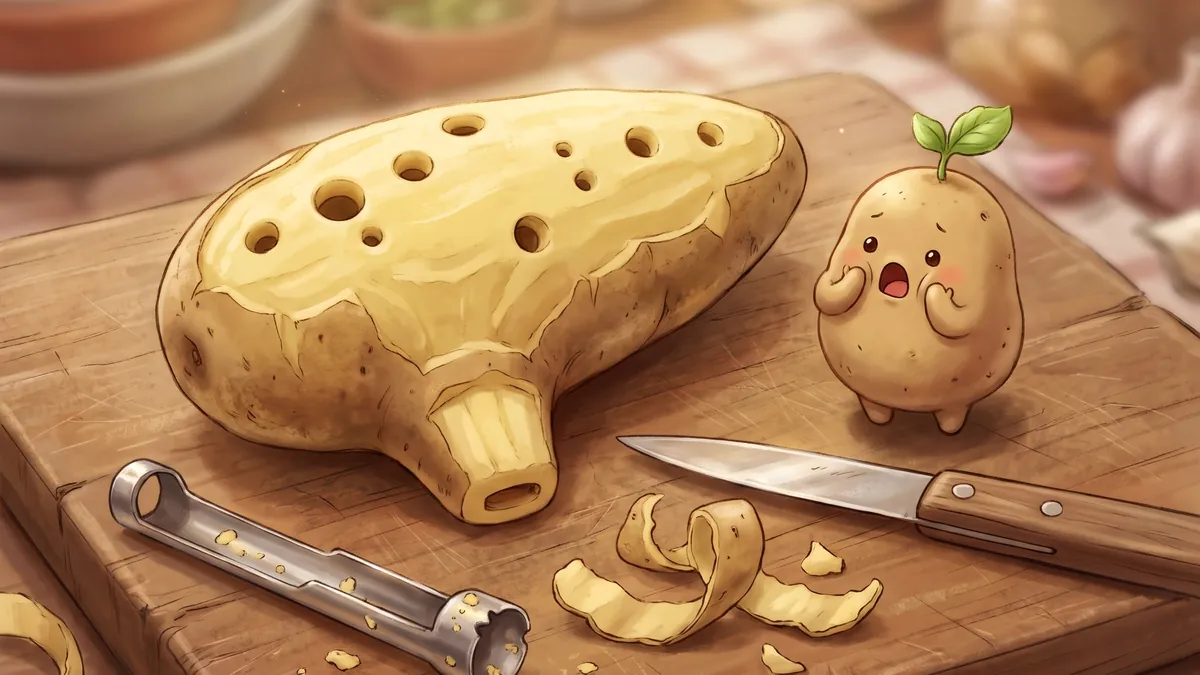
How to Make an Ocarina from a Real Potato
The ocarina's old nickname is the "sweet potato", for its shape. But you can go one step further and make one from a real potato. Musicians have played whole songs on ocarinas carved from potatoes, sweet potatoes and squash. It's a fun kitchen project, and a great way to see how an ocarina works.
Why a potato can sing
An ocarina is a vessel flute: a hollow chamber with a whistle mouthpiece. The material doesn't decide the sound, the shape does. Any firm, airtight vessel with a narrow air channel (the windway) and a sharp edge for the air to split on can make a clear note. A large potato is firm enough to carve and holds air well, so it works.
Grown-ups, please: the cutting and drilling in this project is a job for an adult. Hold the potato down on a cutting board or in a clamp, never in your hand, while you cut or drill.
What you need
- A big, firm potato: a large baking potato or a sweet potato, as round or oval as you can find. A bigger chamber gives a lower, easier note. Don't use a potato that has turned green or is sprouting: the green parts contain solanine, and this is something you put to your lips.
- A spare piece of potato or a carrot: for the plug that forms the windway.
- An apple corer, or a drill with a 10–12 mm bit.
- A small spoon, a melon baller or a bent teaspoon handle: to scoop out the inside.
- A small sharp knife: for the sound window and the edge.
- A thinner drill bit or a skewer: for the finger holes (start around 5 mm).
Step 1: Hollow the chamber
- Wash and dry the potato. Choose one narrow end to be the mouthpiece, and cut it flat.
- Core a straight tunnel from the flat end toward the middle, about 10–12 mm wide and 3–4 cm deep.
- Through that tunnel, scoop out the middle of the potato to make a round hollow. Leave the walls about 1 cm thick all round, and don't break through. A thin wall cracks and leaks; a leak means no sound.
- Shake out the crumbs. The smoother the inside, the cleaner the tone.
Step 2: Make the windway
The windway turns your breath into a thin, flat ribbon of air. It works like the block in a recorder.
- Cut a plug that fits snugly in the tunnel: a cylinder cored from the spare potato, or a piece of carrot.
- Slice a thin, flat sliver off one side of the plug along its whole length, about 1–2 mm deep.
- Push the plug into the tunnel with the flat side up. The thin flat gap between the plug and the top of the tunnel is your windway. Stop the plug about 1 cm short of the hollow.
Step 3: Cut the window and the edge
- On top of the mouthpiece, just past the end of the plug, cut a small square window (about 6–8 mm) straight down into the tunnel.
- Slope the far side of the window from the outside, so it ends in a thin, clean edge. This is the labium, the edge that splits the air.
- Blow gently. The air ribbon should hit the edge, so that some goes over it and some goes under. If you hear only air, slide the plug a little in or out, or trim the edge until it's straight and sharp. When it's right you'll hear a clear, hooting note.
Step 4: Add finger holes and tune them
On an ocarina, the size of a hole matters much more than where it is: every hole you open raises the note, and bigger holes raise it more. So put the holes where your fingers fall comfortably.
- Make one small hole (about 5 mm) for your right index finger. Blow with it covered and uncovered, and compare the two notes with a tuner app.
- To raise a note, widen its hole a little at a time. You can't make a hole smaller again, so go slowly.
- Add more holes the same way. Four holes are enough for a simple scale; a big sweet potato has room for more.
Play it today
A potato is mostly water. Once it's cut, it starts drying out, shrinking and going soft, so the notes drift and the edges lose their shape. Play your potato ocarina the same day. Wrapped and kept in the fridge, it may last another day. Then put it in the compost.
If it doesn't make a sound
- Only air comes out: the windway is too high or too low for the edge. Move the plug, or slice it a little thinner.
- The sound is weak or breathy: the edge is too thick or ragged. Trim it thinner and straighter.
- It used to work: look for a crack, or a hole you broke through while scooping. Any leak lets the air escape.
Next: a clay ocarina that lasts
A potato ocarina is a one-day wonder. When you want one that lasts for years, the same steps work in clay: see how to make a clay ocarina. Then learn your first notes and songs in Potato Flute's lessons.
More from the ocarina library
- How to Make a Clay Ocarina: Step-by-Step DIY GuideLearn how to make a real playing clay ocarina from scratch: pinch pot forming, carving the windway and labium cutting edge, tuning toneholes, and firing.
- A History of the Ocarina: From Ancient Vessel Flutes to BudrioExplore the fascinating 12,000-year history of the ocarina: Neolithic flutes like the Runik ocarina, Chinese xun, Mesoamerican clay instruments, and Giuseppe Donati's 1853 invention in Italy.
- Classical Musicians and Composers Who Embraced the OcarinaDiscover the classical repertoire of the ocarina: from the 19th-century Budrio septets to 20th-century avant-garde masterpieces by György Ligeti and Krzysztof Penderecki.
- How an Ocarina Works: The Acoustics of Helmholtz ResonanceUnderstand the physics of the ocarina: why hole position doesn't matter, how chamber volume sets pitch, and why breath pressure controls intonation.
← Potato Flute home · All articles · Song library