
Potato Flute › Library › The Ocarina: What It Is, Its Kinds, and How to Start
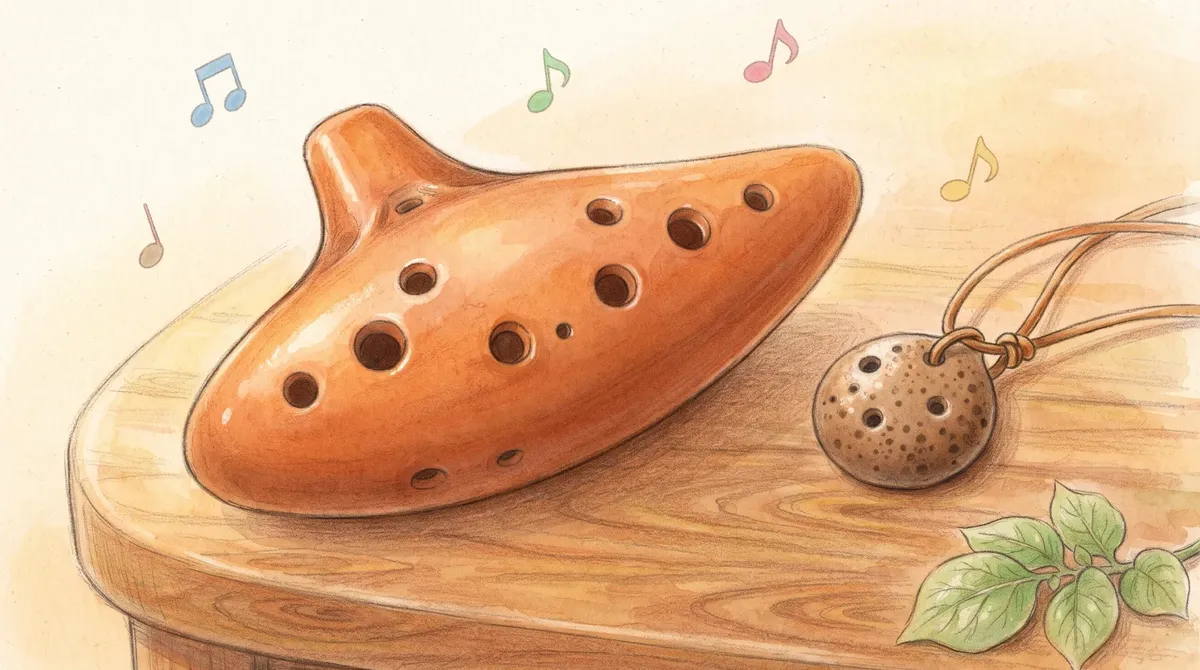
The Ocarina: What It Is, Its Kinds, and How to Start
What an ocarina is and how it makes its sound, the kinds of ocarina (12-hole, 10-hole, pendants, double and triple), which one to get first, and how to start playing with free lessons.
The ocarina is a small flute with a round, hollow body, usually made of clay or ceramic, sometimes of plastic or wood. You blow into a short mouthpiece and cover holes with your fingers, and it answers with a soft, round, almost pure tone. It fits in a pocket or hangs from a cord, and a child can play a first tune on it in a few minutes.
What makes it an ocarina
Most flutes are tubes: the air inside is a column, and the holes along it make it shorter or longer. An ocarina is a vessel: the air inside is one round pocket, and the note depends on how much of the body is open, not on where the holes are. That's why an ocarina's holes can sit almost anywhere, why their sizes matter more than their places, and why it sounds so pure. How an ocarina works explains the physics.
Instruments like it are thousands of years old: clay vessel flutes have been found from China (the xun) to the Americas. The modern ocarina, with its tuned holes and its name ("little goose" in the dialect of Bologna), was made by Giuseppe Donati in Budrio, Italy, around 1853. Read the history of the ocarina.
The kinds of ocarina
- 12-hole: the most common ocarina for songs, held sideways in both hands: ten finger holes, two thumb holes, and two small extra holes for two lower notes. It plays an octave and a fourth.
- 10-hole: the classic design: eight finger holes and two thumb holes, the same notes without the small extra holes. Its highest notes are played with one of two fingerings, the Asian or the Italian (from Budrio).
- Pendants: small round ocarinas worn on a cord, with 4 or 6 holes. Simple and easy to carry, they play one octave (4 holes) or an octave and a third (6 holes).
- Double and triple ocarinas: two or three chambers in one body, each with its own range, for players who want more notes.
- Sizes: a soprano ocarina sounds an octave above an alto, and a bass an octave below. The alto in C is the usual first choice.
Which ocarina to get first
For playing many songs, the usual first choice is a 12-hole alto in C: it's the most common kind, its range fits most tunes, and fingering charts and songbooks are most often written for it. For a small child, a pendant is lighter and simpler, with fewer notes. Whichever you choose, an instrument that's well in tune makes learning much easier than a decorative one.
How to start playing
- Hold it gently, covering each hole with the soft pad of a finger.
- Blow softly and steadily. An ocarina goes out of tune with your breath: too hard and the note goes sharp, too soft and it goes flat.
- Learn a few notes at a time and play short tunes with them. The fingering chart shows every note for 12-, 10-, 6- and 4-hole ocarinas.
- No ocarina yet? Play the virtual ocarina to hear its notes and see their fingerings.
Potato Flute's free lessons teach any kind of ocarina in the browser: they listen to your notes through the microphone and, with the camera, show the fingering on your own hands. When you're ready for tunes, the song library has folk songs and classical melodies. And if you'd like to make one yourself, try a clay ocarina, or even a potato.



More from the ocarina library
- How to Make a Clay Ocarina: Step-by-Step DIY GuideLearn how to make a real playing clay ocarina from scratch: pinch pot forming, carving the windway and labium cutting edge, tuning toneholes, and firing.
- How to Make an Ocarina from a Real PotatoYes, a real potato can be an ocarina. How to hollow it, carve the windway and sound edge, tune the finger holes, and why it only lasts a day or two.
- A History of the Ocarina: From Ancient Vessel Flutes to BudrioExplore the fascinating 12,000-year history of the ocarina: Neolithic flutes like the Runik ocarina, Chinese xun, Mesoamerican clay instruments, and Giuseppe Donati's 1853 invention in Italy.
- Classical Musicians and Composers Who Embraced the OcarinaDiscover the classical repertoire of the ocarina: from the 19th-century Budrio septets to 20th-century avant-garde masterpieces by György Ligeti and Krzysztof Penderecki.
- How an Ocarina Works: The Acoustics of Helmholtz ResonanceUnderstand the physics of the ocarina: why hole position doesn't matter, how chamber volume sets pitch, and why breath pressure controls intonation.
- The Ocarina in Video Games: How a Clay Flute Became MagicWhy the ocarina became gaming's most magical instrument: The Legend of Zelda: Ocarina of Time (1998), Koji Kondo's music, songs that change the world, and how to go from a game controller to a real ocarina.
← Potato Flute home · All articles · Song library